UPI payment pending or debited but not credited at a shop counter: what each status means, RBI T+5 merchant reversal rule, and a no-credit-no-goods counter rule
UPI Payment Pending but Money Deducted: What Your Shop Should Do
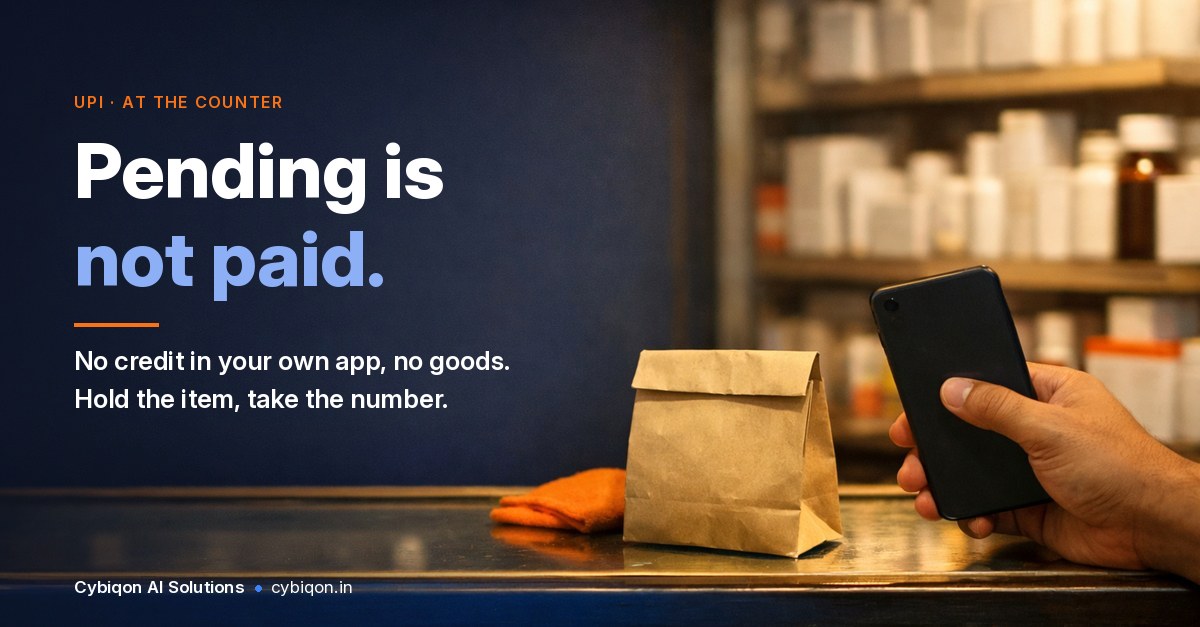
"Paisa kat gaya, bhaiya." The customer turns their phone towards you. The UPI app says pending, a bank SMS says the account was debited, your soundbox is silent and your own app shows nothing. Three people are waiting behind them. This is UPI payment pending but money deducted, seen from the wrong side of the counter, and it is a different problem from a faked screen. If a customer is showing you a "success" screenshot, read our guide on checking a fake UPI payment screenshot instead. This post is about payments that are genuinely stuck.
They are not rare. NPCI data reported by Inc42 on 2 Nov 2026 shows a record 25.47 billion UPI transactions worth ₹31.53 lakh crore in October 2026, about 822 million a day. In the same week MediaNama, citing NPCI data, reported that technical declines at the top 20 remitter banks rose to 0.24% in September 2026 from 0.18% in August.
Below you will find what each screen means, the RBI timeline that decides who gets the money and when, when a pending payment still lands, and a five-second counter rule your cashier can follow without arguing.
UPI payment pending but money deducted: what each screen means
The customer's phone can show one of three things, and each needs a different response from you. None of them means you have been paid. The only screen that counts is the credit on your own merchant app, soundbox or bank statement.
| What the customer sees | What has actually happened | What the counter does |
|---|---|---|
| Pending / processing | The request reached the banks but the final answer has not come back yet. It can still go either way. | No goods. Note number, UTR and amount, set the item aside, wait a few minutes or take cash. |
| Debited, but your app shows no credit | Their bank took the money; your bank has not confirmed receiving it. | Same as pending. The money is in transit or on its way back to them, not with you. |
| Failed / "bank server busy" / declined | The payment did not go through. If money left their account, it must be reversed. | They can pay again: cash, or a fresh UPI payment, since this one has failed. |
The trouble is that the first two look like payment to the customer. Their phone and their SMS both say money has left, so from their side it feels paid. From your side nothing has arrived. Both of you are telling the truth, which is why this one causes arguments and a fake screenshot usually doesn't.
Since June 2025, NPCI has cut the time banks get to respond to a check-status or reversal request from 30 seconds to 10, and the pay request/response from 30 to 15 (as reported by MediaNama and Inc42). A real success or failure normally resolves in seconds. A long "pending" is the exception, and the exception is exactly what you need a rule for.
UPI pending transaction: how long can it take?
Most pending payments settle one way or the other within minutes. slice's help page for merchants says most payments where a customer says money was deducted but the shop did not get it are "reversed or credited within 24-48 hours", and other payment apps' help pages give a similar range. That is the payment company's estimate, not an NPCI or RBI rule.
Why does a pending screen sometimes linger? Our reading (an inference, not something NPCI says in these words) is that two mid-2025 NPCI changes play a part:
- Status checks are rationed. After the 12 April 2025 outage was tied to excessive status-check calls, NPCI circulars told banks to make the first "check transaction status" call no earlier than 90 seconds after the transaction, use at most three checks, and preferably do so within two hours. These were in force by August 2025 (IANS, 29 Apr 2025; Taxscan).
- "Deemed" transactions are reconciled later. When the beneficiary bank (your bank) times out, NPCI's process treats the transaction as "deemed", and that bank must reconcile and confirm what happened. Until it does, the customer's app may keep saying pending.
So the honest answer to "UPI payment pending kitne time me aata hai" is: usually minutes, sometimes up to a day or two, and in every case it must be resolved one way or the other within the RBI deadline in the next section.
RBI's rule for a failed merchant payment: T+5 days, then ₹100 a day
This is where most articles go wrong. They quote "T+1" for every failed UPI payment. That is the rule for a payment between two people. A payment to a shop has a different row in the RBI circular.
The circular is RBI/2019-20/67, DPSS.CO.PD No.629/02.01.014/2019-20, dated 20 Sep 2019, effective 15 Oct 2019. Its annex covers UPI:
| RBI annex row | Situation | Deadline | Compensation if late |
|---|---|---|---|
| 4(a) person-to-person | Account debited but beneficiary account not credited | "auto reversal (R) by the Beneficiary bank latest on T + 1 day" | ₹100 per day beyond T+1 |
| 4(b) payment to merchant | "Account debited but transaction confirmation not received at merchant location" | "Auto-reversal within T + 5 days" | "Rs 100/- per day if delay is beyond T + 5 days" |
Three details matter for your counter:
- T means a calendar date. RBI defines T as "the day of transaction and refers to the calendar date". Sundays and holidays count. Google Pay's help page tells users to wait "5 business days", which is the app's own wording; the RBI rule counts calendar days.
- Compensation is paid suo moto, meaning automatically, without the customer having to complain.
- The rule protects the customer, not you. If their money doesn't reach you, it goes back to them. You are owed nothing until the credit appears on your side, and you owe them nothing either, because you never received it.
So when a customer says "money debited but not received", you can tell them plainly: "If it reaches us, we'll call you. If it doesn't, RBI says your bank must return it within five days of today, or pay you ₹100 a day for the delay."
UPI payment pending but money deducted? The counter rule: no credit, no goods
A cashier at 9 pm with a queue shouldn't have to judge anyone's honesty. They need a rule that is the same for a regular, a stranger and the owner's cousin. Here is one:
- Check your own side only. Your merchant app, soundbox or the payment line on your billing screen. Not the customer's phone, not their SMS.
- No credit, no goods. Say it politely and say it is the shop's rule, not a judgement about them.
- Write down three things: the customer's phone number, the UTR (the 12-digit UPI reference on their payment screen) and the amount.
- Hold the item. Bag it, put the bill and the note on it, keep it behind the counter.
- Cash is fine. If they pay in cash now, the pending UPI payment will either reach you (refund it to them against the UTR) or return to them on its own.
- No second UPI while the first is pending. A fresh UPI payment is fine only once the first shows failed. Otherwise both can land and you will be sorting out a double payment. Google Pay's own help page tells users not to pay again while a payment is in process.
This protects you from honest failures, which are most of them, and from the occasional bad-faith customer alike. There is no need to treat anyone as a suspect; the rule does the work. If the pending payment lands, you will see the credit against that UTR on your side, hand over the item and close the bill.
The shops that find this hardest are the ones that only look at money at closing time. If your UPI credits are matched to bills when you reconcile the galla at day end, an open "pending" bill with a phone number on it shows up as a line to chase, not a mystery shortfall.
An illustrative scene: the ₹1,840 medical store bill
This is an illustrative composite, not a reported case.
Say a medical store with three staff, around 9 pm. A customer buys medicines for ₹1,840 and pays by UPI. Their app shows pending; their bank SMS shows a debit. The soundbox is silent and the store's merchant app shows no credit. The customer says the bank server is busy, the money has gone, and they need the medicines tonight.
Under the counter rule, the cashier:
- notes the phone number, the UTR and ₹1,840 on the bill;
- sets the medicines aside with the bill clipped to the bag;
- explains: if the payment lands, the store calls them; if it fails, their bank must return it within T+5 calendar days under RBI's rule, or pay ₹100 a day after that;
- offers cash now, or a fresh UPI payment once the first one shows failed.
If the customer needs the medicine urgently and pays cash, and the original UPI payment later lands, the store refunds the UPI amount against that UTR. If it later becomes a deemed success, the credit appears in the store's own app against the UTR and the medicines go home with the customer. Either way, nobody has to win an argument.
Money debited but not received: who raises the dispute and where
Here is the part shopkeepers often don't know: only the payer can raise the dispute. The customer started the payment, so the complaint goes through their UPI app or their bank. Google Pay's help page says only the sender can report a transaction, and that after 21 days its partner banks can no longer raise a complaint.
What you can do is give them the information that makes their complaint quick: the UTR, the amount, the date and time, and your shop's UPI ID. Reversals show on their statement as UPI-REV or UPI-RET, according to Google Pay.
If their bank does not reverse it, the escalation path changed this year. The Reserve Bank – Integrated Ombudsman Scheme, 2026 was issued on 16 Jan 2026 and came into force on 1 Jul 2026, replacing the 2021 scheme (RBI press release 2025-2026/1936). The customer complains to their bank first, waits 30 days (or less, if the bank rejects the complaint), and can then file free of charge at cms.rbi.org.in.
Keep this separate from fraud. A stuck payment is a failure for the customer's bank to fix through the steps above; nobody has cheated anyone. A swapped sticker that sends customers' money to a stranger is a different story; see the QR code sticker scam at the counter.
Making the rule stick when it's your billing screen, not your memory
A rule written on a card works on a calm Tuesday afternoon. It slips on the Saturday before Diwali, when two cashiers share one soundbox and the owner is out. The fix is to make your billing system hold the rule for you. This is the kind of software Cybiqon writes, and it needs three things:
- A bill is marked paid only on a confirmed credit in the shop's own account, matched to that bill, not when a cashier ticks "UPI".
- A pending bill stays open with the customer's phone number, UTR and amount, so it can't quietly disappear into "adjusted".
- The day-end report lists open pending bills separately from cash shortfalls, so the owner sees what is waiting to land or waiting to be refunded.
Customers who walk out having "paid" are only one way money goes missing; payments that arrive late and never get matched to a bill are another. If that is the bigger leak for you, our hub on recovering delayed payments covers the credit side of the business.
FAQs
UPI payment pending but money deducted: will the shop get the money?
Maybe. A pending payment can still be credited to the shop, or it can fail and go back to the customer. Treat it as unpaid until the credit shows in your own merchant app, soundbox or bank statement against that UTR.
How long can a UPI transaction stay pending?
Usually a few minutes. slice's merchant help page says most such payments are reversed or credited within 24-48 hours. For a payment to a merchant, RBI's rule requires a failed payment to be reversed within T+5 calendar days, so it must be resolved by then.
Customer says money was debited but I didn't receive it. What should I do?
Check only your own app. If there's no credit, don't hand over the goods. Note the customer's phone number, the UTR and the amount, hold the item, and offer cash. Call them if the payment lands; if it fails, their bank must return the money.
How many days does RBI give for a refund of a failed UPI payment to a merchant?
T+5 days, under row 4(b) of RBI circular RBI/2019-20/67 (20 Sep 2019). If the bank is later than that, it owes the customer ₹100 a day, paid without a complaint. Person-to-person payments are T+1.
Who can raise the dispute, the customer or the shop?
Only the customer who made the payment, through their UPI app or bank. The shop can help by giving them the UTR, amount, time and UPI ID. If the bank doesn't fix it, the customer can escalate under the RBI Integrated Ombudsman Scheme, 2026 at cms.rbi.org.in after 30 days.
Let your billing screen enforce the rule
Cybiqon builds an owned billing and admin panel for a shop's counter. It matches each bill to a confirmed UPI credit in your own account, marks a bill paid only when that credit arrives, and keeps a pending bill open with the customer's number and UTR until the payment lands or fails. The day-end report shows open pending bills next to cash, so the owner sees them before the galla is counted.
It is written for your shop, your billing flow and your staff, not configured from a template, and you own the code. See what that covers on our admin panels and internal software page, or book a 30-minute call with the founders. You can also reach us at +91 9250711473 or support@cybiqon.in.
Conclusion
When a customer's screen says UPI payment pending but money deducted, the money is in transit or on its way back to them, and it isn't yours yet. RBI gives their bank T+5 calendar days to reverse a failed merchant payment, with ₹100 a day after that, so nobody loses by waiting. Your counter needs one rule: no credit in your own app, no goods. Take the number, the UTR and the amount, and hold the item. If you'd like your billing screen to enforce that for you, Cybiqon can build it.
Want this set up for your business?
Book a free call — no tech jargon, no sales pressure. Just honest answers.
What we build for this: Admin panels & internal tools