payment gateway charges in India: fees, GST, refunds, settlement and UPI MDR
Payment Gateway Charges in India 2027: Every Fee, Checked 29 Oct 2026
Payment Gateway Charges in India 2027: Every Fee, Checked 29 Oct 2026
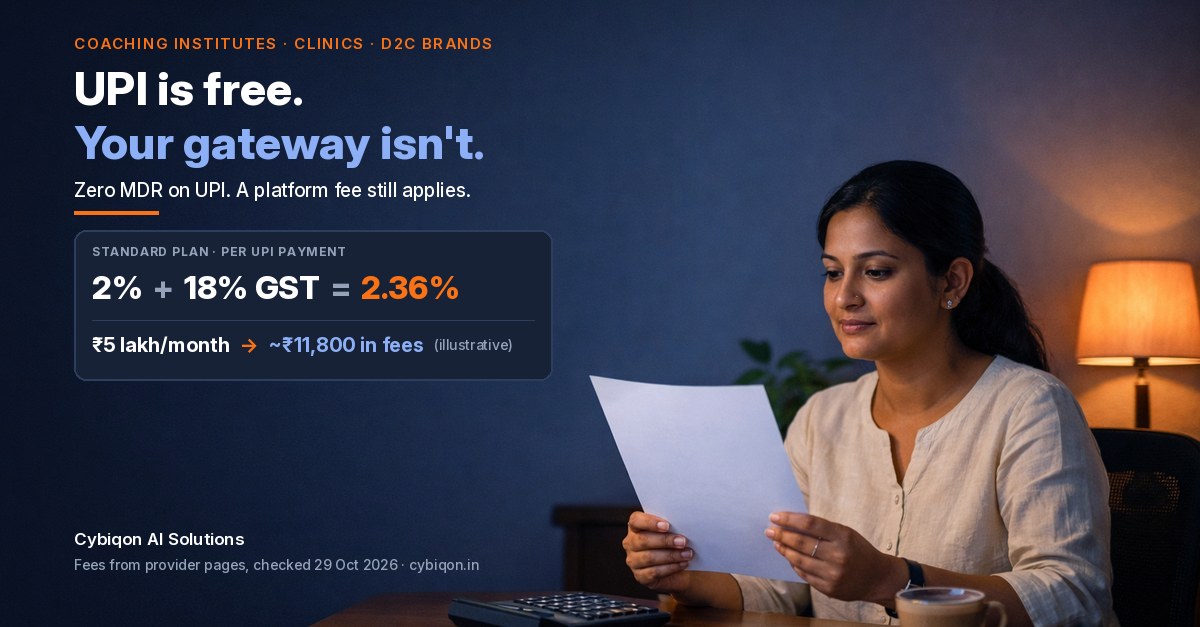
Say you run a D2C skincare brand, a coaching institute in Kota or a clinic in Pune, and ₹5 lakh a month comes in online. On Razorpay Standard or CCAvenue Standard, payment gateway charges in India work out to 2% plus 18% GST on that fee. That is 2.36% effective: ₹2,360 per ₹1 lakh, or ₹11,800 a month on ₹5 lakh. It also applies to UPI, which most people believe is free.
Most comparison pages are written by the gateways. They give undated bands like "1.75%–2.5%" and say UPI has "minimal or no charges". This guide does the opposite. Every figure below is taken from the provider's own page, linked and checked on 29 Oct 2026. Where a provider doesn't publish a number, we say "not published" instead of guessing.
You'll get:
- a fee table for Razorpay, Cashfree, PayU, PhonePe PG and CCAvenue
- why "zero MDR on UPI" still leaves you paying 2%
- where the new UPI ₹2,000 MDR framework stands, and why it hasn't started
- the GST maths, the refund trap and the settlement-time fine print
- a worked example on ₹5 lakh a month, and the levers that lower it
Payment gateway charges in India: the fee table (checked 29 Oct 2026)
All rates are excluding 18% GST, which is charged on the fee, not on your sale. These are standard published plans. Negotiated pricing exists above certain volumes.
| Razorpay Standard | Cashfree | PayU | PhonePe PG | CCAvenue Standard | |
|---|---|---|---|---|---|
| UPI | 2% platform fee (MDR 0) | "As per applicable law"; 0 under new-signup offer | Not published | Not published | 2.00% |
| Domestic cards / netbanking / wallets | 2% | 1.95% standard (per-method split not stated) | 2% (Visa, Mastercard, netbanking, wallets, BNPL) | Standard Plan 1.99%, shown next to "FREE* (T&C Apply)" offer | 2.00% |
| RuPay credit on UPI | 2% on rate card, 2.15% on Razorpay's UPI charges page | Not published | Not published | Not published | 2.15% |
| Corporate / business cards | 2.15% | Not published | Not published | Not published | 3% |
| Amex / Diners | Not separately listed | Amex 2.95%; Diners not published | 3% | Not published | 3% |
| International cards | Up to 3% | 2.99% | 3% | Not published | 3% (multi-currency 3.5%) |
| Settlement | Rate card: T+1/instant. Docs: T+2 working days | T+1 by 8 PM during offer; instant 0.30% + GST | T+2; same-day has a "nominal fee" (not published) | Not published | Per written schedule; Express T+0 on approval, charge not quantified |
| Refunds | Normal ₹0; instant ₹7.99–₹14.99; original fee not reversed | Not published | Not published | Not published | Fees not refunded on refund or chargeback |
| Setup / annual fee | ₹0 / ₹0 | Zero setup; premium AMC amount not given | Zero setup, onboarding and annual fees | Zero setup, zero AMC | No setup fee; ASUC ₹1,200 + GST a year, waived in the first FY |
Sources, all checked 29 Oct 2026: Razorpay pricing (rate card "Last updated: May 2026"), Razorpay settlement docs, Cashfree charges, PayU pricing, PhonePe PG pricing (footer: "accurate as of September 2026"), and the CCAvenue scheme form with its terms.
A few cells need explaining:
- Cashfree's offer: a 0 platform fee on up to ₹20,00,000 GMV for merchants who sign up on or after 21 Jul 2026 (12:00 PM IST), running "till 31-Mar-27". It excludes Amex, Diners, corporate cards, EMI, prepaid, pay later, e-mandate, international and any method with an MDR of 3% or more. It can be withdrawn if credit cards make up 60% or more of your GMV. GST at 18% is still deducted on the standard 1.95%, so the offer is not completely free.
- CCAvenue add-ons: credit card EMI is 2%, cardless EMI is 3.5% and the Shopify plugin adds 0.20%. Recurring mandates cost ₹15 and tokenisation ₹1.25 per token.
- Cashfree EMI and pay later: credit card EMI 2.2%, debit card EMI 1.5%, cardless EMI 1.90%, pay later 2.20%/2.50%.
Razorpay charges: what you pay per transaction
The most common follow-up search is "razorpay charges", so here is the full picture from the Razorpay pricing page, checked 29 Oct 2026:
- 2% on domestic UPI, RuPay debit, domestic cards, netbanking, wallets, pay later and EMI
- 2.15% on corporate and business cards
- Up to 3% on international cards. International bank transfers are 1% with a 0% FX markup.
- ₹0 setup, ₹0 annual maintenance, 18% GST on the fee
- Custom pricing for businesses doing "over Rs. 5,00,000 per month"
Two conflicts on Razorpay's own pages are worth knowing about before you sign:
- Settlement time. The rate card says T+1/instant. The settlements documentation says domestic standard settlement is T+2 working days. Instant settlement carries a "small fee" whose amount is not published. Plan your cash flow on T+2 until your account manager confirms T+1 for your account in writing.
- RuPay credit cards on UPI. The rate card lists them at 2%. Razorpay's UPI transaction charges page says 2.15%. If customers often pay from RuPay credit cards linked to UPI, ask which rate your account will use.
Normal refunds are free. Instant refunds cost ₹7.99 (up to ₹1,000), ₹11.99 (₹1,000–₹25,000) or ₹14.99 (above ₹25,000). Razorpay's refund FAQs also state that fees and taxes are not reversed on refunds. More on that below.
Is UPI free for merchants? Zero MDR vs the platform fee
Both answers are true, which is why the topic causes confusion.
MDR (merchant discount rate) is the network charge on a payment, shared between banks and the card or UPI network. Since 1 Jan 2020, RuPay debit, BHIM-UPI and UPI QR have carried zero MDR under section 269SU of the Income-tax Act and section 10A of the Payment and Settlement Systems Act (CBDT Circular 32/2019; see PIB).
A platform fee is the gateway's own commercial charge for its checkout, dashboard, reconciliation and settlement. The zero-MDR rule doesn't cover it. That is why Razorpay shows "UPI: 2% platform fee (MDR 0)". The network takes nothing, but the gateway still bills 2%.
One existing exception applies above ₹2,000. When a customer pays a UPI merchant from a wallet or prepaid instrument (PPI) rather than a bank account, interchange of up to 1.1% has applied since 1 Apr 2023. NPCI clarified on 29 Mar 2023 that normal bank-account UPI stays free (Business Standard).
So the useful question is how much a business pays on UPI through its own gateway. On a 2% plan, it pays the same rate as on a Visa card.
UPI above ₹2,000: the new MDR framework, and why it hasn't started
On 15 Sep 2026 the Ministry of Finance announced a framework (PIB; full text via TaxGuru):
- 0.4% MDR on person-to-merchant (P2M) UPI payments above ₹2,000, capped at ₹300 per transaction. The cap is reached at ₹75,000.
- Person-to-person payments, and merchant payments of ₹2,000 or less, stay free.
- Small person-to-person merchants (P2PM) taking up to ₹1 lakh a month through QR are exempt.
- A flat ₹5 applies in railways, telecom, insurance, fuel and agri-inputs. Capital markets pay 0.02%, also capped at ₹300.
- The MDR cannot be passed on to customers. The government said about 4% of merchant transactions would be affected.
The share of money affected is far larger than 4%. CareEdge, quoted by Business Today on 15 Sep 2026, found that 67.2% of P2M UPI value comes from payments above ₹2,000, and P2M is 29% of all UPI value. A coaching institute collecting ₹18,000 fees or a clinic billing ₹3,500 a consultation falls on the charged side of the line.
It is deferred. On 13 Oct 2026, NPCI's UPI & Services Steering Committee pushed it back. It is to be "implemented immediately post Diwali at a date to be notified separately" (MediaNama, Daily Pioneer). As of 29 Oct 2026 no new date has been notified, and we won't guess one. The deferral ends when NPCI or the Ministry publishes a notification with a date.
Also unconfirmed: whether gateways will add the 0.4% on top of their 2% platform fee. Cashfree's own blog on the new rules says a zero platform fee does not automatically waive the new network MDR.
For scale, UPI processed 24.07 billion transactions worth about ₹29.37 lakh crore in Sep 2026, up about 23% year on year (NPCI data via StartupTalky).
Is GST charged on payment gateway charges in India?
Yes. 18% GST applies to the gateway's fee, not to the amount your customer paid. A 2% fee becomes 2.36%. On ₹1 lakh that is ₹2,000 in fees plus ₹360 in GST. Gateways deduct both before settling, so your bank credit is already net.
If you're GST-registered, that ₹360 is input tax credit you can claim. Gateways issue a monthly tax invoice for their fees, and that invoice should be matched against your GSTR-2B.
On the new UPI MDR, a claim spread in September that merchants would pay a "separate 18% GST on UPI MDR". The Centre called this a rumour, and noted that ITC is claimable (The Week, 17 Sep 2026).
Payment gateway charges India: the hidden costs in refunds, settlement and annual fees
The headline percentage is only part of the cost. Three other things change the effective rate.
Refunds don't return the fee. Razorpay's FAQs say fees and taxes are not reversed on refunds. CCAvenue's terms (clause 13.8) say fees are not refunded on refunds or chargebacks. Take a D2C brand that refunds 6% of orders. It pays 2.36% on sales it never keeps, and those fees appear in no sales report. Cashfree, PayU and PhonePe PG don't publish their refund fee terms, so ask them in writing.
Settlement time is working capital. T+2 working days means Friday's sales can arrive on Tuesday. Paying to speed this up has a cost: Cashfree's instant settlement is 0.30% + GST, about 0.35%. On ₹5 lakh that is roughly ₹1,770 a month to get money one or two days earlier. If you are already chasing payments that are already late, first ask whether instant settlement solves a real cash gap before paying for it.
Annual fees. CCAvenue's ASUC is ₹1,200 + GST a year, waived in the first financial year and billed each 1 April after that. Razorpay, PayU and PhonePe PG publish zero AMC. Cashfree says "zero setup fees" but doesn't state the premium AMC amount.
The right plan for your business type. A business without GST registration faces different onboarding, which we cover in getting a payment gateway without GST registration. Recurring fees also bring their own charges (CCAvenue lists ₹15 per recurring mandate). See collecting monthly fees on autopay if most of your income repeats every month.
A worked example: ₹5 lakh a month (illustrative)
This is an illustration, not a real client. Say a coaching institute takes ₹5,00,000 a month online: 70% UPI (₹3.5 lakh), 20% Visa/Mastercard (₹1 lakh), 5% netbanking (₹25,000) and 5% corporate cards (₹25,000). Rates are as published on 29 Oct 2026.
| Razorpay Standard | CCAvenue Standard | Cashfree (new signup, offer period) | |
|---|---|---|---|
| UPI ₹3.5L | ₹7,000 | ₹7,000 | ₹0 |
| Cards ₹1L | ₹2,000 | ₹2,000 | ₹0 |
| Netbanking ₹25k | ₹500 | ₹500 | ₹0 |
| Corporate cards ₹25k | ₹537.50 (2.15%) | ₹750 (3%) | Excluded; rate not published |
| Fees | ₹10,037.50 | ₹10,250 | ₹0 + corporate |
| GST 18% | ₹1,806.75 | ₹1,845 | ≈₹1,667 (on 1.95% of ₹4.75L) |
| Monthly total | ₹11,844.25 (2.37%) | ₹12,095 + ASUC from year 2 | ≈₹1,667 + corporate-card fee |
On Razorpay that comes to about ₹1.42 lakh a year. Cashfree's offer is clearly cheaper while it lasts. At ₹4.75 lakh of eligible GMV a month, the ₹20 lakh allowance runs out during month 5, and the campaign ends 31 Mar 2027 either way. After that you pay 1.95% + GST. PayU and PhonePe PG can't be fully calculated because their UPI rates are not published.
If the deferred MDR is notified and the institute's UPI payments are all above ₹2,000 (likely, with ₹18,000 fee instalments), 0.4% × ₹3.5 lakh adds ₹1,400 a month. Whether that comes on top of a gateway's 2% hasn't been confirmed by any provider.
Which payment gateway has the lowest charges in India?
It depends on your payment mix, so there is no single answer. In the example above, the corporate-card slice alone costs 2.15% on Razorpay and 3% on CCAvenue. A brand with many international buyers should compare 2.99% (Cashfree) with up to 3% elsewhere. A clinic paid almost entirely by UPI should look mainly at the UPI row.
Levers that change the number:
- Ask for a quote. At ₹5 lakh a month you're at Razorpay's custom-pricing line. Use your last three months' payment mix as the basis.
- Put UPI intent/QR first at checkout, so customers don't default to cards.
- Collect UPI outside the 2% path. If UPI goes through your bank's own collection product instead of the gateway's 2% plan, you save about ₹8,260 a month (₹7,000 + GST) on the ₹3.5 lakh UPI slice under current rules. Confirm your bank's pricing first. It is not published in a form we could check. Keep fake UPI screenshots in mind: UPI collected outside a gateway still needs server-side confirmation, not a customer's screenshot.
- Reconcile net settlements automatically. A T+1/T+2 settlement arrives as one net amount. Matching it to invoices or student IDs is what catches fees kept on refunds.
What changed since the last version
This post was last updated on 16 Oct 2026. Since then:
- The UPI ₹2,000 section is rewritten. The earlier version described a proposal under discussion. The 15 Sep 2026 framework (0.4%, ₹300 cap) and its 13 Oct 2026 deferral now replace it.
- The table is rebuilt from scratch and dated 29 Oct 2026. CCAvenue is now listed at its published 2.00% (previously "around 1.99%"). PhonePe PG now shows its Standard Plan 1.99% with the limited-period offer. Settlement, refund, international and annual-fee rows are new.
- Paytm PG and Instamojo are removed because we didn't re-verify them for this update. Older figures on debit-card MDR caps and the RBI payment-aggregator deadline are also gone. They aren't charges, and we didn't re-check them.
- The Razorpay conflicts are new: T+1 on the rate card versus T+2 in the docs, and 2% versus 2.15% on RuPay credit on UPI.
FAQs
What are payment gateway charges in India?
As of 29 Oct 2026, standard domestic rates are 1.95%–2% at Razorpay, Cashfree, PayU, PhonePe PG and CCAvenue. Corporate, Amex and international cards cost 2.15%–3%. Add 18% GST on the fee. The common 2% rate is therefore 2.36% effective.
How much does Razorpay charge per transaction?
On the Standard plan: 2% on UPI, domestic cards, netbanking and wallets, 2.15% on corporate cards and up to 3% on international cards, plus 18% GST. There are no setup or annual fees (razorpay.com/pricing, checked 29 Oct 2026).
Is GST charged on payment gateway fees?
Yes, 18% on the fee only, not on the transaction amount. Registered businesses can claim it as input tax credit using the gateway's monthly tax invoice.
Is UPI free for merchants on a payment gateway?
UPI carries zero MDR, but gateways can charge a platform fee. Razorpay and CCAvenue Standard charge 2% on UPI. Cashfree waives its platform fee for eligible new signups until ₹20 lakh GMV or 31 Mar 2027, whichever comes first.
Will UPI above ₹2,000 be charged MDR, and from when?
A 0.4% MDR (capped at ₹300) on merchant UPI payments above ₹2,000 was announced on 15 Sep 2026. NPCI deferred it on 13 Oct 2026 to "post Diwali at a date to be notified separately". No date had been notified as of 29 Oct 2026.
Find your real effective rate
The percentage on a gateway's pricing page is the starting point. Your actual cost also depends on your payment mix, refunds, the settlement schedule and GST. Send us your last settlement report and we'll work out your effective rate.
If it's worth fixing, Cybiqon builds the checkout and reconciliation layer for your business. That means UPI-first payment routing by method, automatic matching of net settlements to orders, invoices or student IDs, and a report that shows fees kept on refunds. It's written for your setup, not configured from a template, and you own the code. See custom websites and checkout builds, or book a 30-minute call. You can also reach us on +91 9250711473 or at support@cybiqon.in.
The takeaway
Payment gateway charges in India look like 2%, but as of 29 Oct 2026 the effective rate is 2.36% once GST is added. That includes UPI on most standard plans, and fees are not returned on refunds. Cashfree's offer is the cheapest option until 31 Mar 2027. The UPI ₹2,000 MDR is on hold until NPCI notifies a date, and that notification is what would change the numbers above. Check your own mix against the table. If you want a second opinion, send Cybiqon your last settlement report.
Want this set up for your business?
Book a free call — no tech jargon, no sales pressure. Just honest answers.
What we build for this: Custom websites