B2B ordering app for distributors: WhatsApp front door, one admin panel posting Sales Orders to TallyPrime, portal vs AI agent, ONDC DigiDukaan
B2B Ordering App for Distributors: Why Retailers Stop Using It
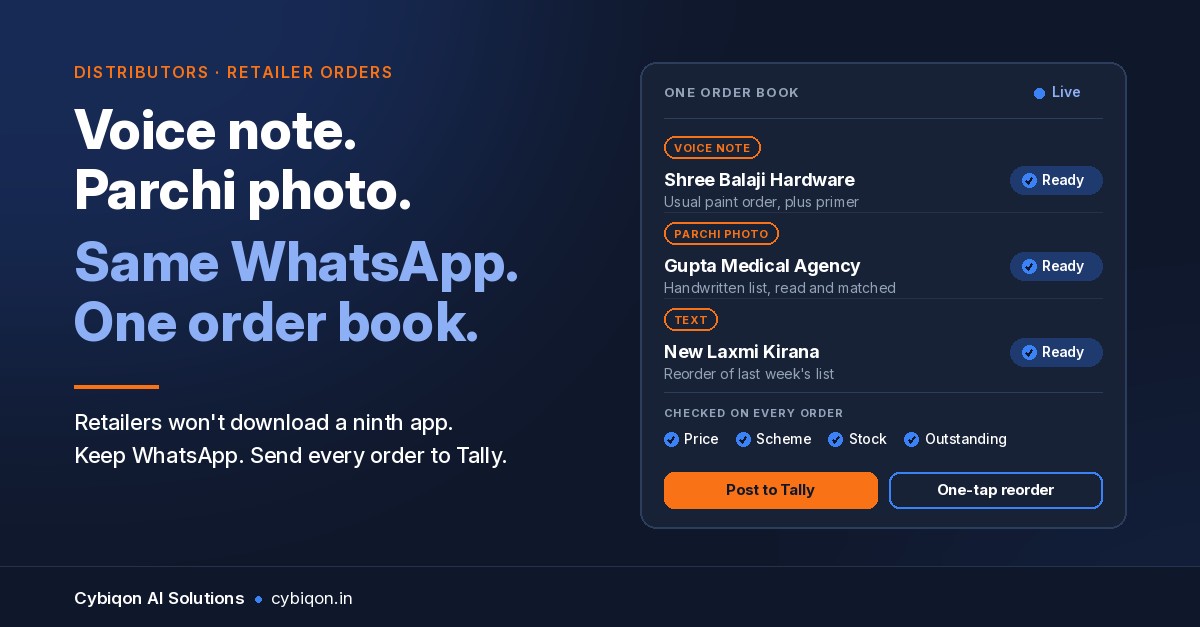
"Bhaiya, same as last week, plus two cartons of the 1-litre." It arrives at 10:40 pm as a voice note. Behind it sit a parchi photo, three Hinglish text orders and a retailer asking whether his scheme still applies. Tomorrow morning someone in your office re-types all of it into TallyPrime. That is why owners start searching for a B2B ordering app for distributors, and why so many of those apps end up unused within a few months.
The retailer is not the problem. He already has several brand apps on his phone, and none of them knows his price, his scheme or what he owes you. Meanwhile the public evidence says that when ordering is simple and the screen shows the right things, retailers keep using it. In Hyderabad, ONDC DigiDukaan reports 16,000+ kirana stores, with 73–78% placing a repeat order every month (September 2026 figures, as reported after a DPIIT-ONDC roundtable on 30 Oct 2026).
This guide covers why retailers abandon separate apps and what brings them back. It also shows how to keep WhatsApp as the front door while every order lands in one panel and posts into TallyPrime. Then it covers when a portal fits and when an AI agent fits, what the published tools cost, and when you don't need any of this.
Why retailers stop using a separate B2B ordering app
Picture a typical FMCG, paint or hardware distributor with a few hundred retailers (a composite drawn from public sources, not a client). Orders come in as WhatsApp text, voice notes and photos of handwritten parchis, often after the shop shuts. A year ago the distributor launched a retailer app. Fifty retailers downloaded it, a dozen used it twice, and by the third month everyone was back on WhatsApp.
The usual reasons are not about technology:
- One more app, one more login. A kirana or hardware counter already deals with several brand and platform apps. A distributor's app has to beat the WhatsApp chat he already has open.
- It shows the list price, not his price. If the app does not know the scheme he was promised, he calls the salesman to confirm, and the app has added a step instead of removing one.
- No stock, no outstanding. If he can't see whether the item is in the godown or how much he owes, he still has to ask.
- Reordering takes longer than typing. "Same as last week" is one line on WhatsApp. In a badly built app it is twenty taps.
Big brands show that a retailer ordering app can work. HUL reports its Shikhar app at about 1.4 million outlets with roughly 70% active every month, covering about a quarter of its general-trade business (company-reported figures from HUL's performance highlights). But HUL has the catalogue depth, scheme budget and credit partners to make retailers open one more app. A regional distributor carrying 30–50 brands cannot fund that, and no retailer will install one app per supplier.
What brings retailers back: four things a B2B retail ordering app must show
Whatever the screen is, an app, a WhatsApp catalogue or a form, these four things decide whether a retailer orders through it a second time.
| What the retailer sees | Why it matters | Where the data lives |
|---|---|---|
| His own price and scheme | No phone call to confirm the rate | Price levels and scheme rules in your system |
| Live stock | No order for something that isn't in the godown | Stock items in TallyPrime |
| Outstanding and credit limit | He knows before ordering whether it will be held | Ledger balance and credit limit in TallyPrime |
| One-tap reorder | "Same as last week" becomes one tap, not twenty | His previous orders |
The credit check matters more than it looks. Setting a credit limit in Tally Prime does not by itself stop an over-limit order from being packed and loaded; that post walks through where the check breaks. Showing outstanding to the retailer at order time, and holding the order in the panel, closes that gap before the truck leaves.
DigiDukaan's numbers point the same way. ONDC says 40% of retailers in an initial study reported holding less inventory for products bought through the network. That is ONDC's own early study, so treat it as a direction rather than a benchmark. The pattern is still clear: retailers come back when the screen saves them a call and a guess.
WhatsApp as the front door: a b2b ordering app without a download
The simplest way to beat "one more app" is to not ship one. WhatsApp's Business Platform (the Cloud API, not the free Business app) already supports ordering inside the chat:
- Catalogue. Your products sit in a Meta catalogue linked to your WhatsApp number.
- Multi-product messages. You can send a retailer a message showing up to 30 products, for example his usual items or this week's scheme lines. He adds quantities and sends a cart.
- Cart orders by webhook. The cart arrives at your server as structured data: product IDs and quantities, not a sentence to decode. Limits apply. A cart allows up to 99 units per item, and once sent it can't be edited, so changes come as a new message.
- WhatsApp Flows. For anything richer, such as "repeat last order", a scheme price or stock shown before he confirms, Flows give you multi-step forms inside WhatsApp. Each step can call a data endpoint on your system, so the price and stock he sees are live.
Then the confirmation goes back as a WhatsApp utility message. Meta has billed per delivered message since 1 Jul 2025. BSP readings of Meta's rate card put India's utility rate at about ₹0.115 per message plus 18% GST, so an order confirmation costs paise. From 1 Oct 2026, utility templates inside an open 24-hour window, and service messages beyond 1,000 free per number a month, are also charged. The full breakdown is in our post on WhatsApp Business API pricing.
The trap is treating WhatsApp as the order book. If carts and texts stay in chats, you have just moved the second order book from paper to phone.
One order book: getting WhatsApp orders into TallyPrime as Sales Orders
Whether an order comes as a cart, a Flow, a salesman's entry or a voice note, it should land in one admin panel. That panel validates it (price, scheme, stock, credit) and posts it to TallyPrime. TallyPrime already has the right place for it:
- Sales Order voucher. Sales Order is a native TallyPrime voucher. Enable order processing in F11 and you get pending orders, then a delivery note and invoice against them.
- Import, or a live push. TallyPrime imports transactions from Excel, XML or JSON (JSON from Release 7.0). Masters such as ledgers and stock items must exist before transactions. For a live push, TallyPrime's XML-over-HTTP interface (default port 9000) accepts requests from your panel on the same network.
- Masters stay in Tally. Ledger names, stock item names and GST details must match exactly. If they don't, the import fails or creates duplicates. Our guide on importing sales vouchers from Excel into Tally Prime covers where that breaks.
One point catches people out. TallyPrime's built-in WhatsApp (Release 4.0 onwards) only sends things out (invoices, reports, payment links). It does not take orders in. To get WhatsApp orders into TallyPrime you still need something in between that reads the order and writes the Sales Order.
The same panel can take orders from your field team. If salesmen book orders on beat, a salesman order booking app tied to Tally should write into the same order book, not a third one.
Portal or AI agent: which B2B ordering app for distributors fits your orders
This is a decision about your order mix, not a feature checklist.
A catalogue or portal fits when known retailers place structured, repeat orders. They pick from a list, see their price and stock, tap reorder. WhatsApp catalogues and Flows, or a simple web or Android ordering screen, cover this.
An AI order-processing agent fits when orders arrive unstructured: Hinglish voice notes, parchi photos, "wahi jo pichhli baar tha". The agent turns these into draft line items matched to your stock item names. A person in your office confirms before anything posts to Tally. Our post on an AI agent for order processing, from WhatsApp to Tally explains how that review step keeps it safe.
Most distributors have both kinds of retailer. The design that works:
- Regular, organised retailers get the catalogue, Flow or app.
- Everyone else keeps sending whatever they send, and the agent drafts it.
- Both write into the same panel and the same Tally company. One order book, one stock figure, one outstanding.
What a B2B ordering app for distributors costs in India (prices, 7 Nov 2026)
Most Indian vendor pages hide pricing. These publish it (checked 7 Nov 2026, excluding GST):
| Tool | Published price | Notes |
|---|---|---|
| Way2Order | Lite ₹1,000/month (annual, 300 buyers); Professional ₹2,500; Business ₹6,000; Business Plus ₹12,500 | Extra user ₹1,000/month; free for buyers |
| Zoho Inventory (India) | Standard ₹999/org/month billed annually (500 orders, customer portal); Premium ₹2,299; Plus ₹4,999; Enterprise ₹7,499 | Inventory system with a customer portal |
| Bizom, FieldAssist | Not published | Sales and distribution platforms; quote on request |
A SaaS subscription is the right choice if its catalogue, pricing rules and Tally connector fit how you sell. A custom build makes sense when your schemes, credit rules or order inputs (voice notes, parchis) don't fit a fixed product, or when you want no per-user fees and to own the code. Add WhatsApp message costs to either option. They are small per order but real at 200 orders a day.
ONDC DigiDukaan: what the 30 Oct 2026 roundtable means for distributors
On 30 Oct 2026, Commerce Minister Piyush Goyal chaired a DPIIT-ONDC roundtable with 40+ FMCG leaders, including Haldiram's, Emami, Veeba and Nilon's. As reported by PIB and Elets eGov, DigiDukaan has connected 21,000+ kirana retailers to 450+ brands across Hyderabad, Jaipur and Mumbai. FMCG companies were urged to scale it nationally.
The timeline so far:
- March 2026: Hyderabad pilot via Qwipo.
- June 2026: 10,000+ retailers and 35+ brands; Jaipur launched on 19 June via Salescode.ai.
- September 2026: Mumbai live; Bengaluru and Delhi NCR "in the coming months".
The context matters. About 1.4 crore kirana stores account for nearly 75–80% of FMCG sales in India (PIB, June 2026). The agreed next steps are a common retailer digital ID, procurement-linked credit, plug-and-play DMS connectors and standard catalogues.
Two caveats. ONDC says DigiDukaan strengthens the retailer-brand-distributor relationship rather than replacing the distributor, so you stay in the chain. And the 73–78% repeat rate is reported for Hyderabad only. The practical point: a distributor whose orders live in chats and parchi photos has nothing to plug into a DMS connector. A clean digital order book, catalogue and price list tied to Tally is the starting point for ONDC, a brand programme or your own app.
When you don't need a B2B ordering app
Be honest about scale before you build anything.
- Under about 20–30 orders a day from a handful of retailers, a well-kept WhatsApp Business catalogue and careful Tally entry may be enough.
- If one brand gives you its own app and most of your volume is that brand, use theirs first.
- If you sell to consumers, not retailers, your problems are COD, returns and courier performance. Start with how to reduce RTO in ecommerce, not a dealer ordering app.
- If your Tally masters are a mess (duplicate items, inconsistent ledger names), clean them first. Any ordering system inherits that mess.
FAQs
What is a B2B ordering app for distributors and how is it different from a DMS or SFA app?
A B2B ordering app lets your retailers place orders themselves, seeing their price, stock and outstanding. An SFA (sales force automation) app is for your salesmen on beat: visits, order booking and attendance. A DMS (distributor management system) is usually a brand's system for tracking the distributor's stock and secondary sales. They can share one order book, and they should.
Can retailers place orders on WhatsApp instead of downloading an app?
Yes. Through the WhatsApp Business Platform, retailers can order from a catalogue, multi-product messages (up to 30 products) or WhatsApp Flows. Carts reach your system by webhook as structured orders. The free WhatsApp Business app can show a catalogue, but it can't feed orders into your system automatically.
How do I get WhatsApp orders into TallyPrime automatically?
Route orders to a panel that checks price, stock and credit, then creates a Sales Order in TallyPrime via XML or JSON import (JSON from Release 7.0) or the XML-over-HTTP interface (default port 9000). TallyPrime's built-in WhatsApp only sends invoices and reports out. It does not take orders in.
How much does a B2B ordering app cost in India per month?
Published prices on 7 Nov 2026: Way2Order from ₹1,000/month (annual, 300 buyers) up to ₹12,500; Zoho Inventory India from ₹999/org/month billed annually up to ₹7,499, excluding GST. Bizom and FieldAssist don't publish prices. WhatsApp message charges are extra.
What is ONDC DigiDukaan and does it replace distributors?
DigiDukaan is ONDC's B2B ordering network for kirana retailers, live in Hyderabad, Jaipur and Mumbai with 21,000+ retailers and 450+ brands (September 2026). ONDC says it strengthens the retailer-brand-distributor relationship rather than replacing distributors.
What Cybiqon would build for your order desk
For a distributor taking a couple of hundred retailer orders a day on WhatsApp, Cybiqon would build the ordering layer around how you already sell. Retailers keep ordering in WhatsApp through a catalogue or Flow that shows their own price, scheme, stock, outstanding and "repeat last order". Every order, whether a cart, salesman entry or voice note, lands in one admin panel that applies your credit rules and posts Sales Orders into TallyPrime.
It is written for your business, not configured from a template, and you own the code, with no per-retailer fees. Admin panels start from ₹29,999, scoped per build, typically 4–6 weeks. WhatsApp automation is a separate service from ₹19,999. Book a 30-minute call, or reach us at +91 9250711473 or support@cybiqon.in.
Conclusion
A B2B ordering app for distributors fails when it asks retailers to change habits and gives them nothing in return. It works when the screen shows their own price, scheme, stock and outstanding, and reorder is one tap. DigiDukaan's Hyderabad reorder rate and HUL's Shikhar both point the same way. For most distributors, the front door can stay WhatsApp. What has to change is behind it: one panel, one order book, posted into TallyPrime. If that is the system you need, Cybiqon can scope it with you on a 30-minute call.
Want this set up for your business?
Book a free call — no tech jargon, no sales pressure. Just honest answers.
What we build for this: WhatsApp automation